You can download this article as a PDF document using the link below.
PDF document about The Dart Performance Screen
INSIGHT
Dart Performance
Compare your dart sets side by side — which barrel, weight and flight actually plays best.
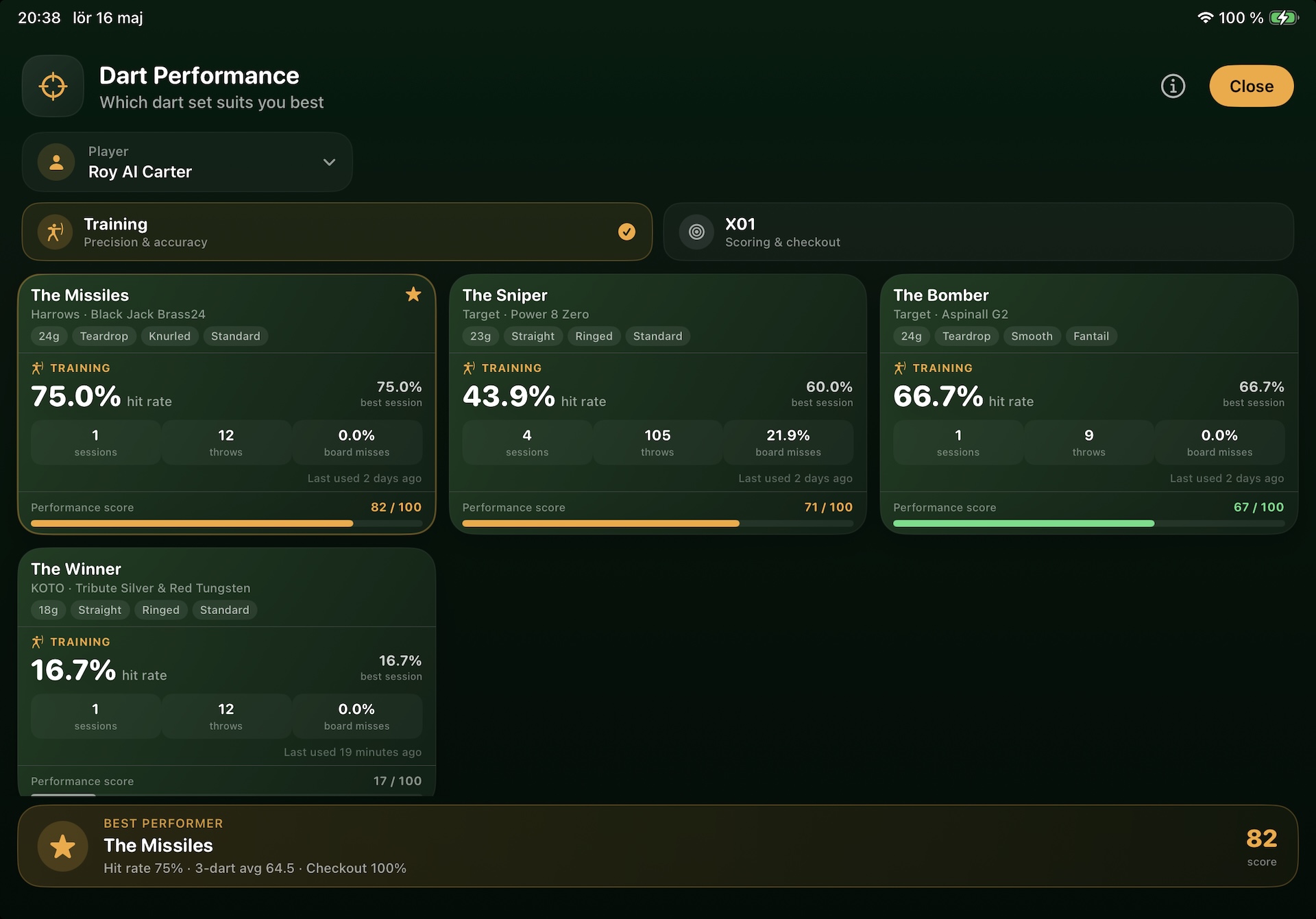
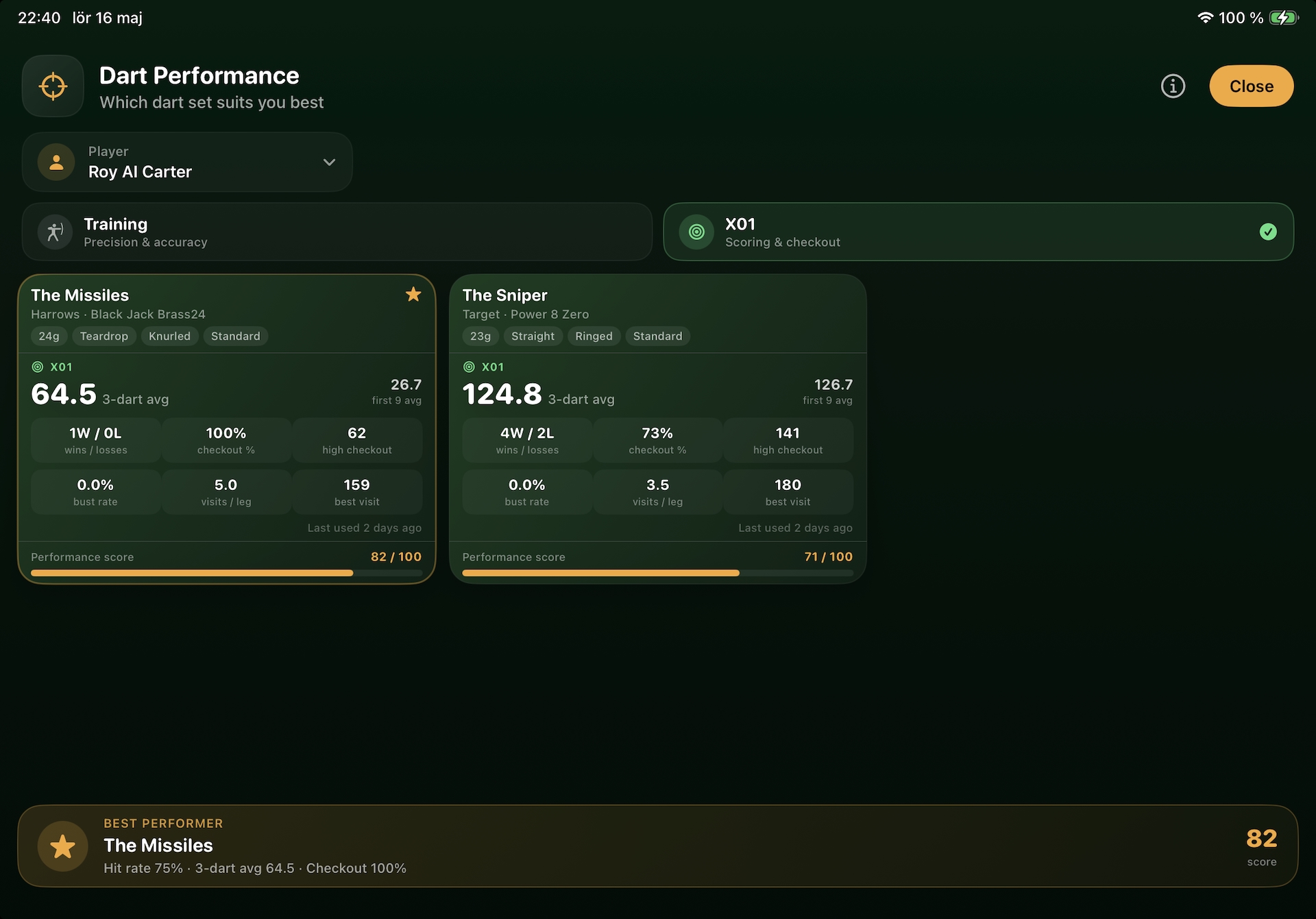
Dart Performance answers a single question: ”Which of my dart sets is performing best for me right now?” The view loads every dart set you own (or have used), splits the metrics into Training and X01, ranks them with a single composite score and crowns a winner at the bottom of the screen.
Picking the player
The player menu at the top selects whose stats are computed. There’s no ”All Players” option here — comparing equipment only makes sense per person, since two players using the same set will throw it differently. The first active player is selected automatically when you open the view.
Which dart sets show up
The list is the union of two sources, so you’ll never miss a set:
- Sets owned by the selected player (created in Profiles → Player Preferences).
- Sets the player has actually used in a completed training session or X01 game — even if the set is owned by a different player.
Borrowed a friend’s darts for a leg? They’ll appear here automatically as soon as you finish a session or game with them selected. No need to add the set to your profile.
Training tab
Each card shows precision-focused metrics aggregated across every completed training session in which the set was selected:
Hit rate Hits ÷ valid throws across every training throw with the set. Board misses are excluded from the denominator (they go into their own pill below). This is the headline number on the card.
Best session The single highest hit rate across all sessions with this set. Useful as your personal ceiling — ”this set can do this on a good day”.
Sessions Number of completed sessions where the set was used.
Throws Total dart throws recorded with this set in training.
Board misses Percentage of throws that flew off the board (true bounce-outs and floor misses).
X01 tab
X01 cards focus on scoring power and finishing reliability:
3-dart avg (Total visit score ÷ total darts thrown) × 3, across every completed visit in games with this set including busts. Bust visits contribute 0 to the score but their darts still count, matching the PDC standard darts statistic.
First 9 avg Per-leg average of the player’s first three visits with this set, computed with the PDC formula (sum of those three visits’ scores ÷ their darts × 3) and then averaged across all the player’s legs. Busts in the opening three visits count as 0 score with their darts in the denominator, so they correctly drag the average down. Captures opening scoring power per game and is averaged across legs so a single big-scoring leg doesn’t dominate.
Wins / Losses Count of legs/games marked as winner = true vs false for the player on this set.
Checkout % Successful checkouts ÷ visits where the starting score was ≤170 and the visit completed. Busts at ≤170 count as missed opportunities (they stay in the denominator), matching standard darts convention.
High checkout Largest single checkout finish recorded with the set.
Bust rate Busted visits ÷ total visits (completed + busted). Lower is better.
Visits per leg Average visits to close a leg you actually won. Legs you didn’t win don’t pollute the denominator — those are abandoned or in-progress and would inflate the average.
Best visit Highest single-visit score recorded with this set.
Empty domains
If you’ve only used a set in training, it disappears from the X01 tab (and vice versa). The view never invents data — switching tabs just hides sets that have nothing to show.
The composite Performance Score
Each card has a 0–100 score bar at the bottom and a single number. The score blends the three most representative metrics with fixed weights:
score = (hitRate × 40) + (min(3dartAvg ÷ 80, 1) × 40) + (winRate × 20)
The weights only count for components that exist for the set — a set with only training data is scored on its 40-point hit-rate slot alone, normalised back to 100. The three colour bands on the bar are gold (≥70), green (≥40) and grey (below). The set with the highest score across the entire roster gets a gold star on its card and shows up in the ”Best performer” banner at the bottom of the screen.
The 80-point cap on 3-dart average is deliberate: at world-class scoring (~100+) you’d hit the ceiling even with a moderate hit rate, and the score would stop discriminating between sets. 80 is a sensible top-out for amateur to club-level play.
The recommendation banner
Once at least one set has data, the gold banner at the bottom shows the best performer with a one-line strength summary (e.g. ”Hit rate 54% · 3-dart avg 72.1 · Checkout 18%”). It’s purely score-driven — no manual ranking — so it updates the moment you finish a session that beats your current best.
Pagination
Sets are shown three to a page so the cards stay readable on iPad in either orientation. With more than three sets, swipe horizontally or tap the dots indicator to flip pages. The pages stay in sync with the active tab — switching from Training to X01 resets to page 1.
Performance
All stats are computed on demand inside a single read transaction — switching player triggers one round-trip and a few seconds at most even with hundreds of sessions. There’s no separate dart-set analytics table to keep in sync; everything is derived from your session and game records.